The science · The six principles
Six principles ProfilEd is built on.
Five come from a century of learning science. The sixth is our own. Each one starts with a true story, the person who saw it first in their own words, the evidence, and exactly where you’ll meet it inside ProfilEd.
No account needed · about five minutes
Principle I
Tutor, don’t tell.
Chicago, early 1980s
Benjamin Bloom’s graduate students compared three ways of teaching the same material: a normal class, a class with regular checks for mastery, and one-to-one tutoring. The tutored students did so much better that the average tutored student outperformed about 98% of the students taught in the normal class.1
Bloom called scaling that up “the 2 sigma problem”, because no society could afford a tutor for every student.
“I believe an important task of research and instruction is to seek ways of accomplishing this under more practical and realistic conditions than the one-to-one tutoring, which is too costly for most societies to bear on a large scale.”
What the research shows
- Later work found a smaller but still large tutoring advantage, and found well-designed step-by-step tutoring systems nearly as effective as human tutors (0.76 vs. 0.79 effect size).2
- AI that gives students answers raised practice scores 48% but cut exam scores 17% once it was removed. A tutor that gave hints instead removed most of that harm.3
- An AI tutor built on learning-science principles produced more than double the learning gains of an active in-class lesson.4
- Practice that feels effortful, like recalling or explaining, feels slower but lasts far longer than practice that feels easy. Psychologists call these desirable difficulties.5
How ProfilEd applies it
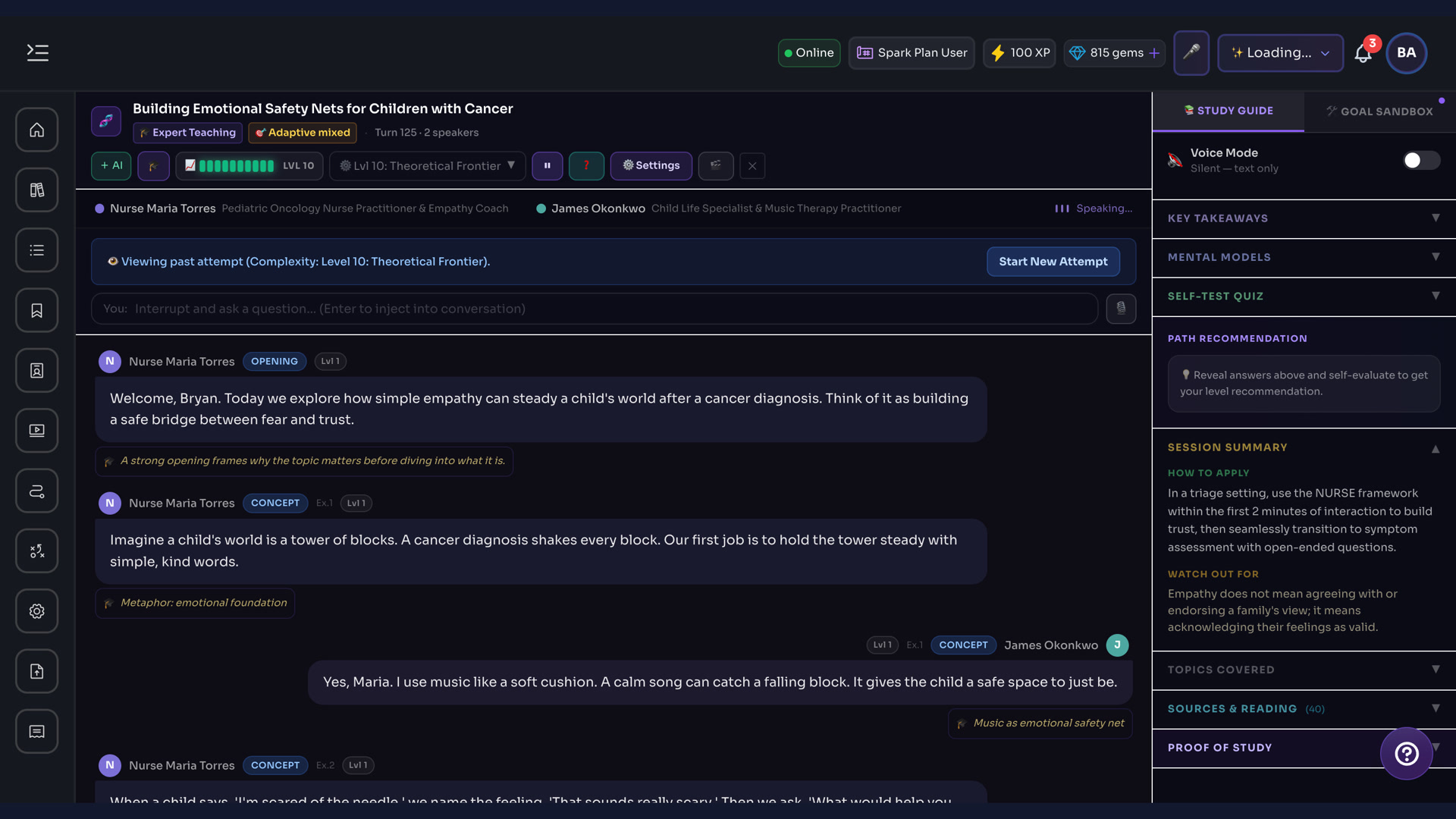
- ProfilEd never hands you the answer. ALICE asks.
- Every mode — check-in, study session, interview, story quest — makes you produce the thinking.
- It tutors one person at a time, every day, at the cost of software rather than the cost of a person.
See it: Study Sessions Daily Check-ins
Want to feel the difference between being told and being asked?Try it in a free check-in
Principle II
If you can’t explain it, you don’t know it yet.
Pasadena, June 1974
Richard Feynman’s commencement speech at Caltech was about “cargo cult science”: people who copy the outward form of science, the vocabulary and the rituals, without the understanding underneath. His warning was that the hardest person to catch doing this is yourself.6
Psychologists later measured it. Ask people how well they understand everyday things — a zipper, a toilet, a bicycle — and they rate themselves highly. Ask them to explain it step by step, and their ratings collapse.7
“The first principle is that you must not fool yourself — and you are the easiest person to fool.”
“What a child can do in cooperation today he can do alone tomorrow.”
What the research shows
- People overrate how well they understand things until they try to explain them: the illusion of explanatory depth.7
- Explaining material to yourself, and teaching it to others, both reliably deepen understanding.9,10
- Recalling something strengthens it far more than re-reading it. Practice testing is rated among the most effective study techniques; re-reading and highlighting among the least.11,12
- People grow fastest just beyond what they can do alone, with support that adjusts as they improve: Vygotsky’s “zone of proximal development”.13,14
How ProfilEd applies it
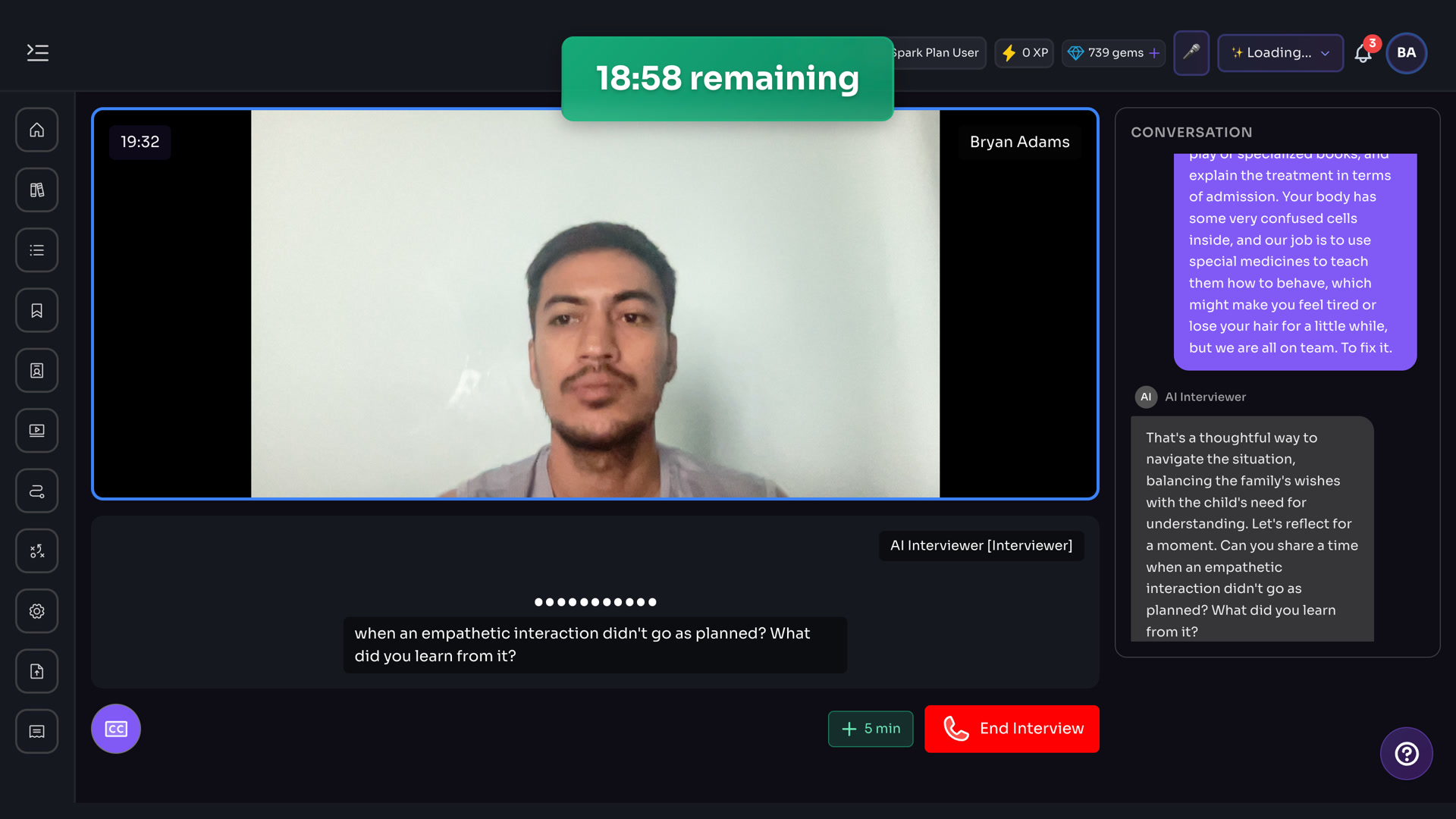
- Check-ins are spoken, not typed or multiple-choice. Saying it out loud is where the illusion breaks.
- In Feynman teach-back mode, the AI plays the student and you teach it.
- When you can name a concept but can’t explain it, ProfilEd records that as a gap.
- You’re never asked to recognize the right answer from a list. You produce one.
- ALICE doesn’t let a vague answer or a borrowed piece of jargon pass. It asks what you mean, in your own words.
- Interview follow-ups get harder as your answers get stronger, keeping you at the edge of what you can do.
See it: Study Sessions Interviews
Pick something you’re sure you understand. Try explaining it out loud.Try it in a free check-in
Principle III
Every idea needs a worthy opponent.
Coleman, Texas, 1974
On a 104-degree afternoon, Jerry Harvey’s father-in-law suggested driving 53 miles to Abilene for dinner in a car with no air conditioning. Everyone agreed. Four hot, dusty hours later, they discovered that not one of them had wanted to go. Each had agreed because they thought the others wanted to.15
Harvey’s point: groups fail less from conflict than from agreement nobody believes. AI has the same problem. It is built to be agreeable.
“Organizations frequently take actions in contradiction to what they really want to do and therefore defeat the very purposes they are trying to achieve.”
What the research shows
- AI language models measurably tend to tell people what they want to hear, even when the person is wrong. Researchers call this sycophancy.16
- Having several AI agents debate each other improves the accuracy of their reasoning.17
- Doing beats watching: across 225 studies, students in traditional lectures were 1.5 times more likely to fail than students in active-learning classes. Learning deepens most when ideas are built in conversation.18,19
How ProfilEd applies it
- The job of challenging you is split into separate roles. Professor AI asks Socratic questions about why you think what you think. Devil’s Advocate argues the other side on purpose.
- ALICE hosts. No single voice is trying to please you and challenge you at the same time.
- In study sessions you watch the experts disagree, then interrupt and argue back, by voice or chat.
See it: Study Sessions Interviews
Bring an idea you’re confident in, and let it be argued with.Try it in a free check-in
Principle IV
Fix the root, not the symptom.
Toyota, 1950s
When a machine stopped on Taiichi Ohno’s production line, the easy fix was to replace the blown fuse. Ohno asked why the fuse blew, then why that happened, five times over, until the answer was a missing metal screen letting shavings into a pump. Replace only the fuse and the machine stops again tomorrow.20
Learning fails the same way. Struggling with something advanced is usually a symptom. The cause is a foundation underneath it that never set.
“By repeating why five times, the nature of the problem as well as its solution becomes clear.”
What the research shows
- When learners must master the foundations before moving on, they consistently outperform those who don’t. A meta-analysis of mastery-learning programs found an average effect size of about 0.52.21
- In 1958 the US Navy’s Polaris missile program planned its work as a network of dependent steps rather than a list. The technique, PERT, became standard for managing complex projects.22 Complex knowledge has the same shape: some things can’t be learned until others are in place.
- Bloom found mastery checks alone closed much of the gap to one-to-one tutoring.1
How ProfilEd applies it
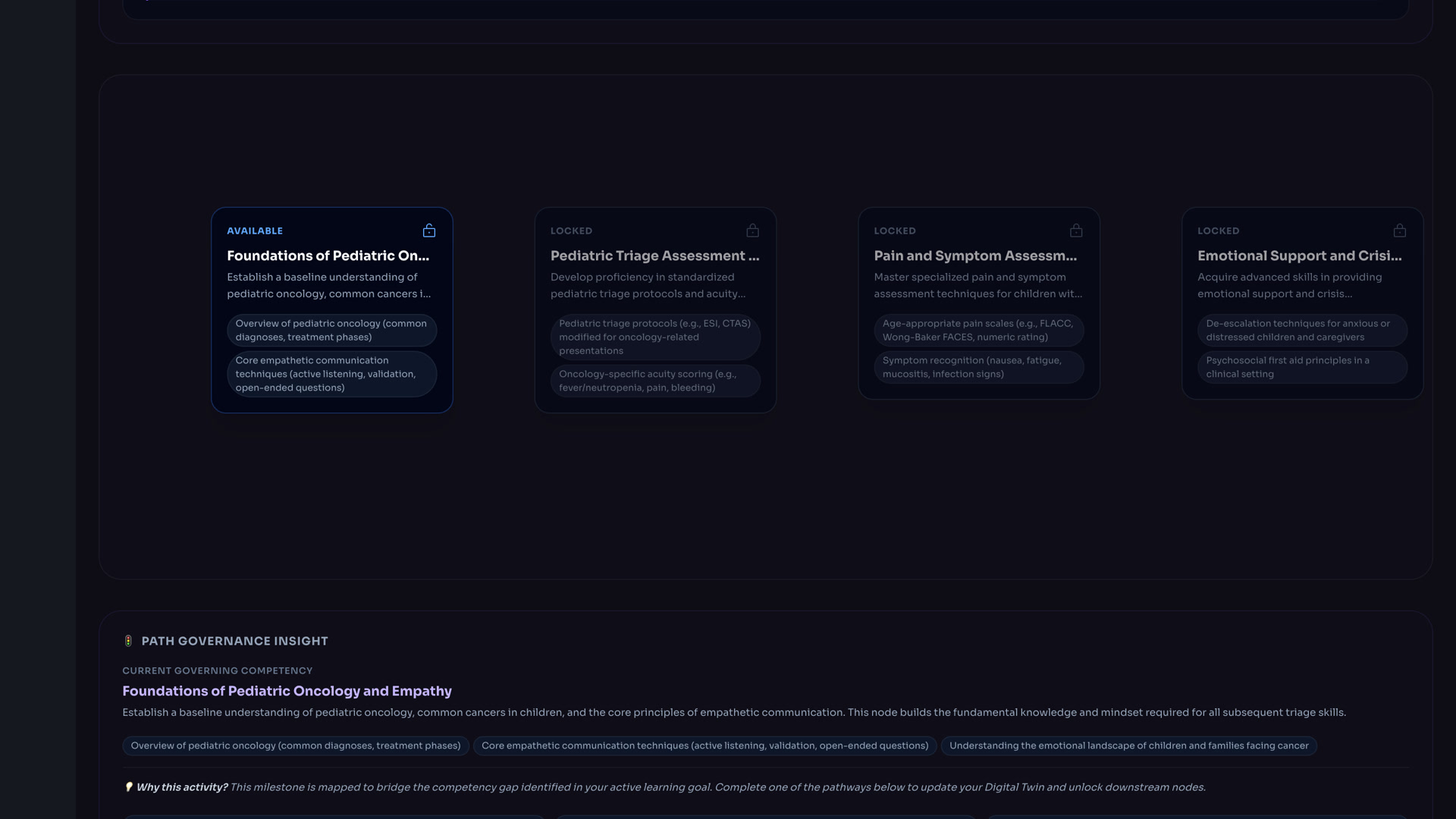
- The Curriculum Graph maps what you’re learning as a network of what depends on what, not a list of chapters.
- When something won’t click, you can see the foundations underneath it.
- Being built now: when you’re stuck, ProfilEd will trace back automatically to the foundation that’s missing, and take you there first.
- Nothing is marked mastered because you watched or read it. It has to be shown in different ways first. That’s the seven-step chain below.
See it: Curriculum Graph
Name the thing that won’t click. Find what’s underneath it.Try it in a free check-in
How a topic becomes “mastered”
- Not started
- Studying
- Studied
- Scenario done
- Pre-interview
- Interview
- Spoken defence
- Mastered
These are the actual states each topic moves through in ProfilEd. Watching, reading or clicking “done” never skips a step.
Principle V
Change the belief, not just the answer.
Three Mile Island, March 1979
At 4am, a relief valve at the nuclear plant stuck open. A light on the control panel went out, telling operators the command to close it had been sent. Nothing told them whether the valve had actually closed. For more than two hours, well-trained people made careful, logical corrections, each one based on a wrong belief about that valve. Each one made things worse.
Chris Argyris called this the difference between single-loop learning (fix the action) and double-loop learning (question the belief that produced it).23,24
“Most people define learning too narrowly as mere ‘problem solving’ … But if learning is to persist, managers and employees must also look inward.”
What the research shows
- Lasting change comes from questioning the assumptions behind a decision, not only correcting the decision.23
- In a field study at a call center, staff who spent 15 minutes a day reflecting on what they’d learned performed 22.8% better within ten days than colleagues who kept working.26
- People who decide exactly what they’ll do and when are far more likely to follow through than people who only set a goal.27
How ProfilEd applies it
- The daily check-in is five minutes of structured reflection, out loud.
- Over weeks, ProfilEd tracks what you believe and how sure you sound, the threads you keep returning to, and the patterns you steer around.
- Every check-in ends with a closing gift: one specific thing to do tomorrow, and the question you’ll start with next time.
See it: Daily Check-ins My Unified Journey
Five minutes out loud tonight. One specific thing to do tomorrow.Try it in a free check-in
Principle VI
Earn the right to speak.
Athens, 399 BC
Told by the Oracle at Delphi that no one was wiser than him, Socrates went looking for someone who was. He questioned the politicians, the poets and the craftsmen of Athens, and found the same thing each time: they were sure of far more than they could defend. His only advantage, he concluded, was that he didn’t claim to know what he didn’t.28
AI has the opposite habit. It answers everything, with the same confidence whether it knows or not. We wrote this principle for ourselves.
“I do not think I know what I do not know.”
“Do not say that for which you lack adequate evidence.”
“The system should know when it doesn’t know. Silence is better than wrong.”
What the research shows
How ProfilEd applies it
- Every insight ProfilEd offers you has to pass a confidence check first.
- It won’t name a pattern in your thinking until it has seen it in at least three sessions.
- It never says you’ve resolved something just because you said so. It needs evidence from your practice.
- If the evidence isn’t there, it says nothing. No generic encouragement as a fallback.
See it: How ProfilEd thinks
Notice what it doesn’t say in your first session, as well as what it does.Try it in a free check-in
Grice’s four rules of good conversation, as checks in code
| Grice’s maxim (1975) | What ProfilEd checks before it speaks |
|---|---|
| Quality Don’t say what you lack evidence for | Confidence rules. A pattern needs 3+ sessions and high confidence. |
| Quantity As much as needed, no more | Output must be the right length. And most of the time, the right amount is nothing. |
| Relation Be relevant | Output must be specific to you, built from your own sessions. |
| Manner Be clear | No generic or stock language. If it fails, nothing is sent. |
name a pattern⇔sessions ≥ 3∧confidence = high∧output passes checks
One of ProfilEd’s real rules, written as logic. Every kind of claim has one.
Also built in
Three more findings ProfilEd takes seriously.
Practice in situations that look like real ones.
Realistic judgment scenarios and structured interviews are among the better predictors of how people actually perform at work.33,34 Story Quests put you in branching dilemmas. Interviews follow a structured, STAR-based format.
Feedback about the work, not about you.
Feedback aimed at the person, rather than the task, often makes performance worse.31 After an interview, ProfilEd’s 30-second audio reframe tells you what to do next. It doesn’t grade you as a person.
How you say it, and how long you take.
In 1868 the Dutch physiologist F. C. Donders showed that the time a person takes to respond reveals the mental work happening in between. It became the foundation of reaction-time research.35 ProfilEd notices how long you hesitate before each choice in a Story Quest. In interviews it notes your speaking pace, pauses before answering, filler words and tone. These are prompts for a better question, never a verdict on their own.
Sources (35)
Every figure and quote on this page, with a link to the original where one exists.
- Bloom, B. S. (1984). The 2 Sigma Problem: The search for methods of group instruction as effective as one-to-one tutoring. Educational Researcher, 13(6), 4–16. Source ↗
- VanLehn, K. (2011). The relative effectiveness of human tutoring, intelligent tutoring systems, and other tutoring systems. Educational Psychologist, 46(4), 197–221. Source ↗
- Bastani, H., Bastani, O., Sungu, A., Ge, H., Kabakcı, Ö., & Mariman, R. (2025). Generative AI without guardrails can harm learning: Evidence from high school mathematics. PNAS, 122(26). Source ↗
- Kestin, G., Miller, K., Klales, A., Milbourne, T., & Ponti, G. (2025). AI tutoring outperforms in-class active learning: an RCT introducing a novel research-based design in an authentic educational setting. Scientific Reports, 15, 17458. Source ↗
- Bjork, R. A. (1994). Memory and metamemory considerations in the training of human beings. In J. Metcalfe & A. Shimamura (Eds.), Metacognition: Knowing about Knowing, 185–205. MIT Press.
- Feynman, R. P. (1974). Cargo Cult Science. Caltech commencement address, published in Engineering and Science, 37(7). Source ↗
- Rozenblit, L., & Keil, F. (2002). The misunderstood limits of folk science: an illusion of explanatory depth. Cognitive Science, 26(5), 521–562. Source ↗
- Vygotsky, L. S. (1962). Thought and Language. MIT Press.
- Chi, M. T. H., de Leeuw, N., Chiu, M.-H., & LaVancher, C. (1994). Eliciting self-explanations improves understanding. Cognitive Science, 18(3), 439–477. Source ↗
- Fiorella, L., & Mayer, R. E. (2013). The relative benefits of learning by teaching and teaching expectancy. Contemporary Educational Psychology, 38(4), 281–288. Source ↗
- Roediger, H. L., & Karpicke, J. D. (2006). Test-enhanced learning: Taking memory tests improves long-term retention. Psychological Science, 17(3), 249–255. Source ↗
- Dunlosky, J., Rawson, K. A., Marsh, E. J., Nathan, M. J., & Willingham, D. T. (2013). Improving students’ learning with effective learning techniques. Psychological Science in the Public Interest, 14(1), 4–58. Source ↗
- Vygotsky, L. S. (1978). Mind in Society: The Development of Higher Psychological Processes. Harvard University Press.
- Wood, D., Bruner, J. S., & Ross, G. (1976). The role of tutoring in problem solving. Journal of Child Psychology and Psychiatry, 17(2), 89–100. Source ↗
- Harvey, J. B. (1974). The Abilene Paradox: The management of agreement. Organizational Dynamics, 3(1), 63–80. Source ↗
- Sharma, M., et al. (2023). Towards understanding sycophancy in language models. arXiv:2310.13548. Source ↗
- Du, Y., Li, S., Torralba, A., Tenenbaum, J. B., & Mordatch, I. (2023). Improving factuality and reasoning in language models through multiagent debate. arXiv:2305.14325. Source ↗
- Freeman, S., et al. (2014). Active learning increases student performance in science, engineering, and mathematics. PNAS, 111(23), 8410–8415. Source ↗
- Chi, M. T. H., & Wylie, R. (2014). The ICAP framework: Linking cognitive engagement to active learning outcomes. Educational Psychologist, 49(4), 219–243. Source ↗
- Ohno, T. (1988). Toyota Production System: Beyond Large-Scale Production. Productivity Press.
- Kulik, C.-L. C., Kulik, J. A., & Bangert-Drowns, R. L. (1990). Effectiveness of mastery learning programs: A meta-analysis. Review of Educational Research, 60(2), 265–299. Source ↗
- Malcolm, D. G., Roseboom, J. H., Clark, C. E., & Fazar, W. (1959). Application of a technique for research and development program evaluation. Operations Research, 7(5), 646–669. Source ↗
- Argyris, C. (1977). Double loop learning in organizations. Harvard Business Review, September. Source ↗
- Argyris, C., & Schön, D. A. (1978). Organizational Learning: A Theory of Action Perspective. Addison-Wesley.
- Argyris, C. (1991). Teaching smart people how to learn. Harvard Business Review, May–June. Source ↗
- Di Stefano, G., Gino, F., Pisano, G. P., & Staats, B. R. (2016). Making experience count: The role of reflection in individual learning. Harvard Business School Working Paper 14-093. Source ↗
- Gollwitzer, P. M., & Sheeran, P. (2006). Implementation intentions and goal achievement: A meta-analysis of effects and processes. Advances in Experimental Social Psychology, 38, 69–119. Source ↗
- Plato. Apology, 21d. In Five Dialogues, tr. G. M. A. Grube. Hackett.
- Grice, H. P. (1975). Logic and conversation. In P. Cole & J. Morgan (Eds.), Syntax and Semantics, Vol. 3: Speech Acts, 41–58. Academic Press.
- ProfilEd internal architecture specification, “ProfilEd Intelligence Architecture: The Foundation of Everything the Product Says and Does” (2026).
- Kluger, A. N., & DeNisi, A. (1996). The effects of feedback interventions on performance. Psychological Bulletin, 119(2), 254–284. Source ↗
- Box, G. E. P., & Draper, N. R. (1987). Empirical Model-Building and Response Surfaces. Wiley.
- McDaniel, M. A., et al. (2001). Use of situational judgment tests to predict job performance. Journal of Applied Psychology, 86(4), 730–740. Source ↗
- Sackett, P. R., Zhang, C., Berry, C. M., & Lievens, F. (2022). Revisiting meta-analytic estimates of validity in personnel selection. Journal of Applied Psychology, 107(11), 2040–2068. Source ↗
- Donders, F. C. (1868/1969). On the speed of mental processes (W. G. Koster, Trans.). Acta Psychologica, 30, 412–431. Source ↗
Five minutes. Out loud. See what it finds.
Just your first name. Your first check-in is free, and you’ll leave with something to do tomorrow.
No account needed · about five minutes
- Do I have to talk out loud?
- For the daily check-in, yes: it’s a voice conversation and you don’t type. Interviews can be voice or fast text, and study sessions can be voice or chat.
- Can I do it on my phone?
- Yes. The check-in runs in the browser on your phone, tablet, or computer.
- Do I need an account?
- Not for your first check-in. A free account keeps your conversation and picks up where you left off.
- Is it private?
- The check-in is confidential, and nothing is shared unless you share your footprint link. For exactly what’s stored, read the Privacy Policy.
- What does it cost?
- The first check-in is free, with no account or card, and new accounts get starter gems to try deeper things. ProfilEd Pro is $19 a month for unlimited use. Full details are on the pricing page.