3 of 3 · How to use it

Your first fifteen minutes, and what to do when it gets hard.

Open it, say something rough, and read what comes back. This is the screen-by-screen guide, so nothing in the first sitting is a surprise.

Start a free check-in

No account needed · about five minutes

Before you start

What do you need to bring?

  • Five quiet minutes.It’s a spoken conversation. A closed door helps.
  • A microphone.The check-in runs in the browser on your phone, tablet, or computer. Nothing to install.
  • Your first name.That’s all it asks to begin. No account, no card.
  • One real thing on your mind.The first question is about what’s taking up your mental space. You can’t prepare for it, and you don’t need to.
Time
A check-in is about five minutes. Other activities vary, and you choose when.
How you talk
Check-ins are voice. Interviews are voice or fast text. Study sessions are voice or chat.
Cost
Your first check-in is free, with no account or card. New accounts get starter gems for deeper things, and ProfilEd Pro is $19 a month for unlimited use. See pricing.

Words we use

A plain-language list.

You’ll meet these as you go. Here’s what each one means.

Check-in
The five-minute spoken conversation you can have every day.
Closing gift
What you get at the end of a check-in: a core tension, the trap to avoid, one small action and tomorrow’s question. There’s a short audio version too.
Core tension
The thing underneath what you said, named more clearly than you named it.
ALICE
The voice you talk to in a check-in. It remembers what you said and picks up from there.
Gems
The free starter credit you spend on deeper things, like a detailed interview report or a longer session. New accounts get some when they sign up.
Interview
A role-specific AI interview that pushes on your answers, then scores you.
Audio reframe
A 30-second spoken summary of an interview result, written to tell you what’s next rather than to grade you.
Story Quest
A scene where you make decisions and defend them to AI characters who push back.
Five doors
The five ways to work on a gap from a quest report: Teach, Test, Assess, Role Play, Reflect.
Study session
Two AI experts, a Teacher and a Challenger, argue a concept while you watch, then you explain it back.
Reflection pause
A short break in a study session where you record yourself explaining the idea in your own words.
Curriculum graph
Your goal turned into a map of concepts. Each concept is a node you can open and study.
Footprint
The record that builds as you go: streak, activities, verified skills, score trends and saved explanations. You choose whether to share it.
Your first fifteen minutes

From open tab to your first picture.

  1. Open the check-in and type your first name.

    You’ll see “Start your first conversation,” with four promises: 5 minutes, free, confidential and an instant audio gift.

  2. Press “Start conversation” and speak.

    Allow the microphone. A timer counts down from five minutes. The first question is “What’s taking up the most mental space for you right now?” Rough and specific beats polished.

  3. When it asks again, stay with it.

    A follow-up means you were close to something. The sentence you almost skipped is usually the useful one.

  4. Read your closing gift.

    Core tension, the trap to avoid, one small action, tomorrow’s question. There’s a short audio version too.

  5. Choose “Create free account — keep my conversation.”

    It saves what you just said, and you get starter gems to spend on deeper reports and sessions.

  6. Tell it your goal, in your own words.

    For Arjun it was “I want to become a Director of Product… I don’t know how to prove it.” It sharpens the goal, and you confirm it.

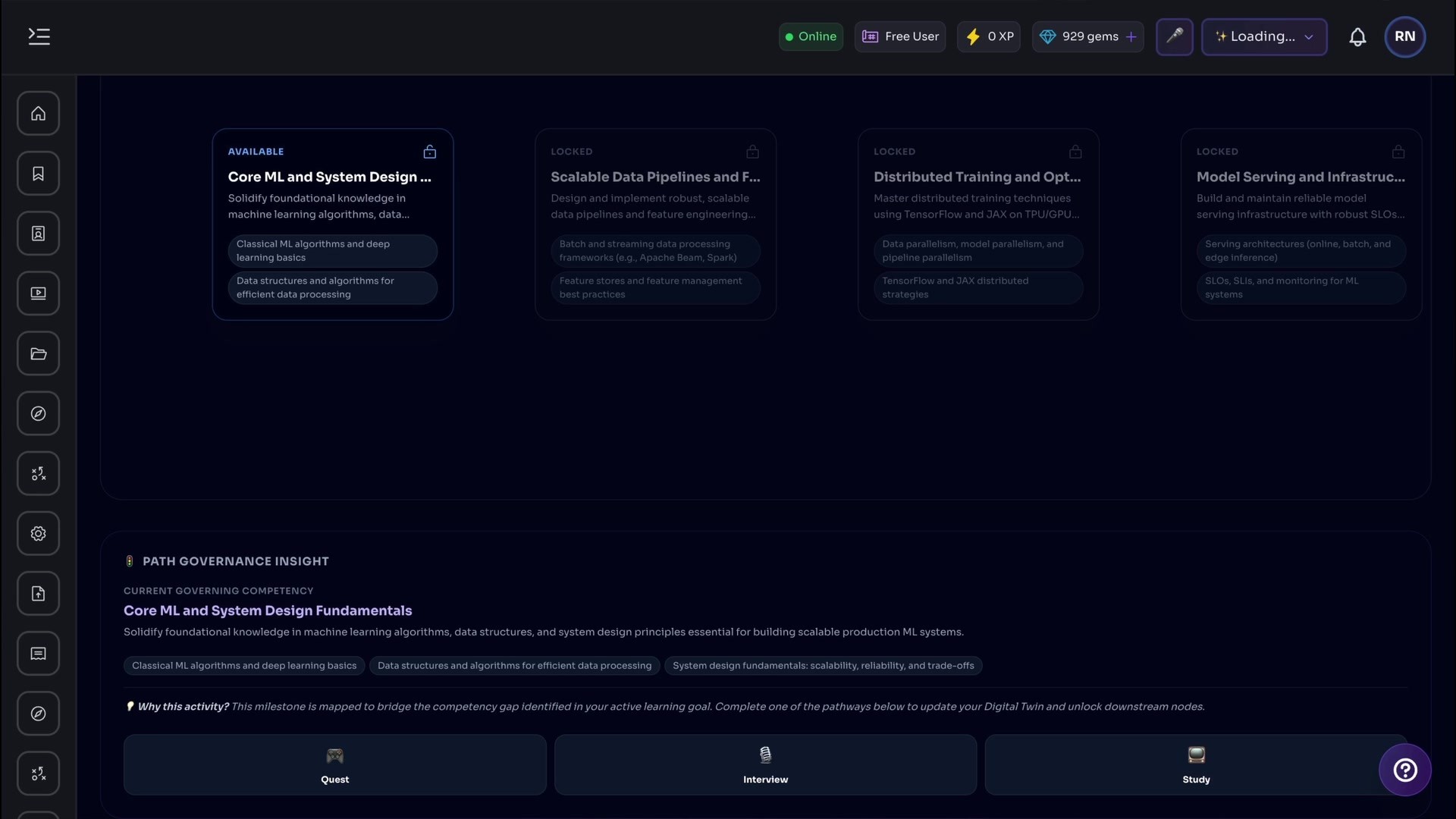
  7. See your first map.

    Within seconds, five concepts appear for your goal, with “+11 more nodes in your full curriculum.” The gap now has a shape.

  8. Choose where to go next.

    Arjun chose “Start with my daily check-in,” and that’s a good default. Come back tomorrow for the question it left open.

Setup is a handful of screens, not one. The ones that matter most are your goal, your target role and your organization. You can skip the rest and come back to them.

Your first map

How to read your curriculum graph.

This is the map you see after you set your goal. Here is how to choose what to do next from it.

Look at your active goal and your mastery summary. Some concepts are open now and some are locked until you’ve covered what comes before. Open any concept to see what it needs, then choose how to work on it: a Quest, an Interview or a Study session. Read the full Curriculum Graph guide →

3:02
Watch: How to Read Your Curriculum Graph

Reading your results

Each report answers one question.

Interview resultA score, with strong and weak areas. A short summary, then a 30-second audio reframe. The detailed report costs gems. Arjun’s: 64% overall, strong on structure, weaker on defending decisions. Read the Socratic Interview guide →
Story reportA technical score out of ten, the concepts you were missing, and five doors into each gap: Teach, Test, Assess, Role Play, Reflect. Choose the way you want to work on it. Read the Story Quest guide →
Study sessionTwo AI experts debate a concept. You can interrupt, or spar with them. Some sessions also ask you to pause and reflect, and may quote your own words back later. Read the Study Session guide →
Your footprintYour streak, completed activities, verified skills and score trends in one place. Export a PDF, or share a link if you choose to. Read My Unified Journey guide →

Your first week

Start from where you are.

Three people, three first weeks. Take the one that sounds like you.

Arjun · I freeze under scrutiny

Check-in first, then an interview.

Say what’s on your mind and do the small action. Then take an interview picked for your role.

  1. Day 1. Check-in and small action.
  2. Day 2. The question you left open.
  3. Day 3. An interview. Read the reframe.
  4. Day 4 to 6. A Story Quest that tests the same gap.
Priya · I have a target and a clock

Graph first, then an interview.

Set a specific goal, read the curriculum map, then test yourself against it.

  1. First. Set your goal and read your map.
  2. Then. An interview. See where it’s thin.
  3. Then. Study the weak concepts.
  4. Watch. Your score trend. It’s your fuel.
Kiran · I know it but can’t explain it

Interview, then a study session.

An interview shows how clearly you explain what you know. Then work on the weak area with the experts.

  1. First. An interview. See where you lose people.
  2. Then. A study session. Pause and reflect when it asks.
  3. Then. Retry the interview.
  4. Watch. Accessibility and recovery rise.

When it gets hard

The moments people worry about.

  • “I missed a day.”

    Fine. The next check-in asks what happened. Nothing resets, and there’s no penalty to pay off first.

    “Welcome back. Two days since we talked. What happened?”

  • “I don’t know what to say.”

    Say that. “I’m not sure” is information, and it will ask about it. Specific and rough beats polished and vague.

  • “That number felt bad.”

    A 64% can be confronting, and it’s meant to be useful. Read the audio reframe first. It’s written to say what’s next, not to grade you.

    “You know this. You’ve just never practiced it out loud.”

  • “It got me wrong.”

    It only knows what you’ve told it, and it’s always a little behind you. Say so next time. When it offers a theory, it asks whether it’s right, and means it.

  • “I’d rather not talk out loud.”

    The daily check-in is voice. Interviews also offer fast text, and study sessions can be voice or chat. You can begin there while you get used to it.

Five minutes. Out loud. See what it finds.

Just your first name. Your first check-in is free, and you’ll leave with something to do tomorrow.

Start a free check-in

No account needed · about five minutes

Do I have to talk out loud?
For the daily check-in, yes: it’s a voice conversation and you don’t type. Interviews can be voice or fast text, and study sessions can be voice or chat.
Can I do it on my phone?
Yes. The check-in runs in the browser on your phone, tablet, or computer.
Do I need an account?
Not for your first check-in. A free account keeps your conversation and picks up where you left off.
Is it private?
The check-in is confidential, and nothing is shared unless you share your footprint link. For exactly what’s stored, read the Privacy Policy.
What does it cost?
The first check-in is free, with no account or card, and new accounts get starter gems to try deeper things. ProfilEd Pro is $19 a month for unlimited use. Full details are on the pricing page.